

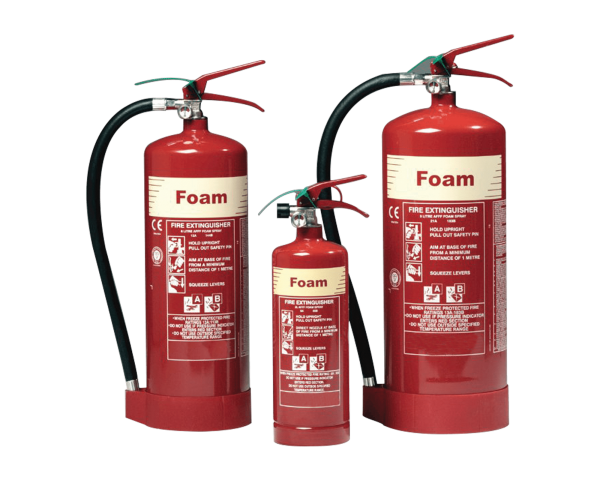
Foam Fire Extinguisher
- Description
- Specification
Description
Foam fire extinguishers are effective and versatile devices used primarily for Class A and B fires. They work by creating a blanket that smothers flames, cuts off oxygen, and cools the burning material, which also prevents re-ignition.
- Mechanism: The foam is discharged as a spray that forms a thick, insulating blanket over the burning material. This blanket effectively separates the fuel from the oxygen supply, smothering the fire. The water content provides a crucial cooling effect to reduce the temperature below ignition point and helps prevent the fire from starting again.
- Target Fires: They are a versatile solution for environments with mixed fire risks.
Class A: Fires involving ordinary combustible solids like wood, paper, textiles, and some plastics.
Class B: Fires involving flammable liquids and liquefied solids such as petrol, diesel, paints, solvents, and lubricants.
- Limitations: Foam extinguishers should not be used on fires involving live electrical equipment (unless specifically certified via a 35kV conductivity test) or cooking oils and fats (Class K/F fires).
- Advantages: Compared to dry powder extinguishers, foam causes less collateral damage, leaves a residue that is easier to clean, and the foam adheres to surfaces, which helps prevent re-ignition.
Specifications vary depending on the capacity and model (portable or wheeled), but general technical characteristics include:
| Specification | Details (Portable Units) |
| Agent Capacity | Commonly available in 6 liter and 9 liter sizes; other sizes range from 2L to 50L+ wheeled units. |
| Extinguishing Agent | Aqueous Film-Forming Foam (AFFF) concentrate mixed with water (e.g., AFFF 3% or 6% concentrate). |
| Propellant | Nitrogen gas (N2) or CO2 cartridge, depending on the design. |
| Working Pressure | Typically around 14 - 15 bar (approx. 100 psi for UL listed units). |
| Test Pressure | Hydraulic test pressure is often around 30 - 35 bar. |
| Discharge Time | Varies by size, but typically ranges from 15 seconds to over 40 seconds. |
| Discharge Range | Around 3 to 5 meters (10-15 feet). |
| Operating Temperature | Standard range is typically +5°C to +55°C (some frost-proof models have a wider range like -20°C to +60°C). |
| Fire Rating | Varies by specific product and standards organization (e.g., 2A:10B, 3A:20B, 4A:144B). |
| Construction | Deep drawn steel or stainless steel cylinders with corrosion-resistant coatings and brass valve assemblies. |
Related Products
-
 Quick View
CO2 Fire Extinguisher
-
 Quick View
Water Type Fire Extinguisher
-
 Quick View
Fire Extinguisher Cabinet
-
 Quick View
Dry Powder Fire Extinguisher